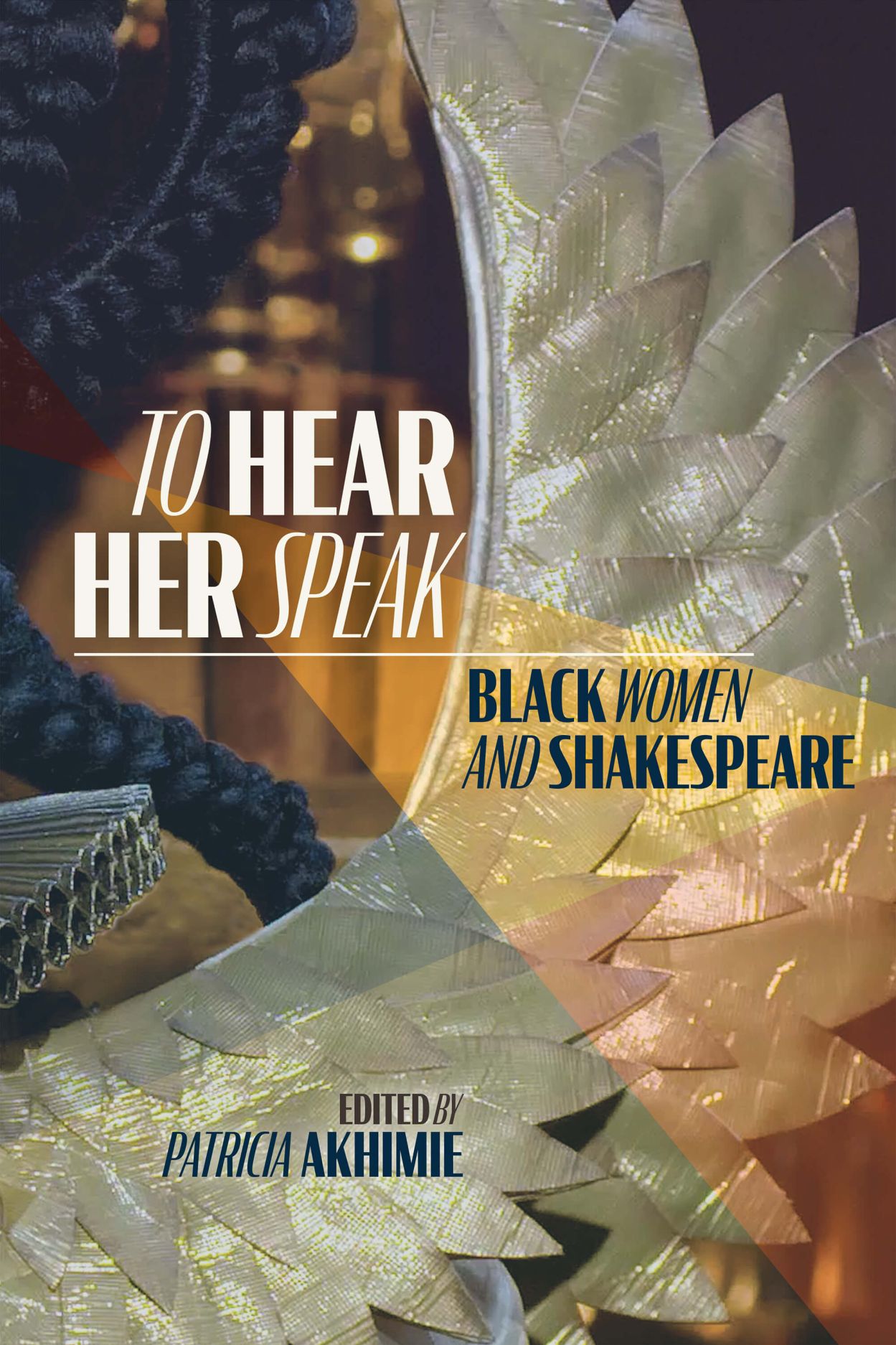
Recovers a previously hidden theater and performance history of Black women engaging with Shakespeare as actors, playwrights, costume designers, and directors.
This catalog documents and expands on the Folger Shakespeare Library’s 2026 exhibition To Hear Her Speak: Black Women and Shakespeare, curated by Dr. Patricia Akhimie, the Director of the Folger Institute and an internationally recognized scholar in the field of premodern critical race studies. To Hear Her Speak explores the presence of Black women in the early modern world, the histories of Black women in Shakespearean performance both on and off stage, and how Black women as writers, thinkers, and artists have utilized Shakespeare’s language, forms, stories, and characters for their own purposes and to diverse ends. Akhimie shares how these women, their histories, and their cultures are represented (and misrepresented) through the eyes of early modern European artists and writers, and allows readers to listen for and learn from the voices of Black women in a wide variety of forms of expression.
384 pages | 150 halftones | 9 x 12 | © 2026
Medieval and Renaissance Texts and Studies
Art: Art--General Studies
Literature and Literary Criticism: British and Irish Literature


Table of Contents
A Note from the Director of the Folger Shakespeare Library, Farah Karim-Cooper
Introductions
1. Dedication to Laura Burford
2. To Hear Her Speak: Black Women, Shakespeare, and Early Modern Texts, Patricia Akhimie
3.Against Elision: Joining Expertise to Turn from Object to Visitor, Verónica E. Betancourt
Part I. Black Women in Early Modern Europe: 1560–1700
4. Black Lives: Black Women on and off the Early Modern Stage, Rebecca Adusei
5. African Women and European Costume Books, Caroline Duroselle-Melish
6. Mapping Margins: Early Modern Atlases and Black Women’s Bodies, Maria Isabel Maza
7. Flexing / New Realm: Figuring Black Women in Early Modern Europe, Verónica E. Betancourt
Part II. Shakespeare, Sugar, Slavery: 1620–1820
8. Turner’s Hall Plantation and a Shakespeare First Folio, Patricia Ann Lott and Patricia Akhimie
9. The Bards: Phillis Wheatley and William Shakespeare, Patricia Ann Lott and Patricia Akhimie
10. Sugar and Abolition, Patricia A. Matthew
11. The Politics of Paleness, Ashley Buchanan
Part III. Taking the Stage: 1820–Present
12. The Invisible Black Woman, Ayanna Thompson
13. Jet, Ebony, and Tan: Black Performance and the Black Press, Atesede Makonnen
14. Queen’s Breakthrough: Diana Sands as Lady Macbeth and Cleopatra, Shanelle E. Kim
15. From Good Times to Macbeth: Esther Rolle Across American Screen and Stage, Cen Liu
16. Afrofuturism and Costuming Shakespeare, Patricia Ann Lott and Patricia Akhimie
17. Unsung Black Women of the Federal Theatre and the “Voodoo” Macbeth, Anna Kutter
18. We Call Her “The Queen”: Performing Macbeth in Colonial Zimbabwe, Eli Cumings
Part IV. Black Thought on Shakespeare: 1880–Present
19. Ida B and Lady M, Atesede Makonnen
20. Anna Julia Cooper, Dunbar High School, and Shakespeare as Racial Uplift, Anna Kutter
21. Black Women Shakespeareans and the Radical Legacy of Atlanta University, Patricia Cahill
22. Winner, Winner: Frances DeBerry Takes the Stage, Shanelle E. Kim
23. Embracing the Stars: Lorraine Hansberry on Shakespeare, Tapiwa Gambura
24. Safiya Sinclair and the Poetry of Linguistic Rebellion, Kathryn Vomero Santos
25. Maya Angelou’s Shakespeare: The Meeting of Genius, Patricia Akhimie, Tapiwa Gambura, and Kim F. Hall
Part V. Epilogue: Lost Things
26. 1622, a lost play — The Black Lady (1622) and Early Modern Black Ladies, Brandi K. Adams
27. 1821, a lost playbill — Black Actresses, Shakespeare, and Pre-Jacksonian New York, Joyce Green MacDonald
28. 1911, a lost textbook — Henrietta Vinton Davis: “Reading” Shakespeare as Political Activism, Kim F. Hall
29. 1953, a lost broadcast — Looking Beyond: Toni Morrison, William Shakespeare, and the Art of Re-vision, Dalton Greene
30. 1989, a lost hip-hop musical — Beats and Bard: Remixing Shakespeare in Club XII, Cen Liu
Afterword
31. Emblematic Women, Noémie Ndiaye
Index