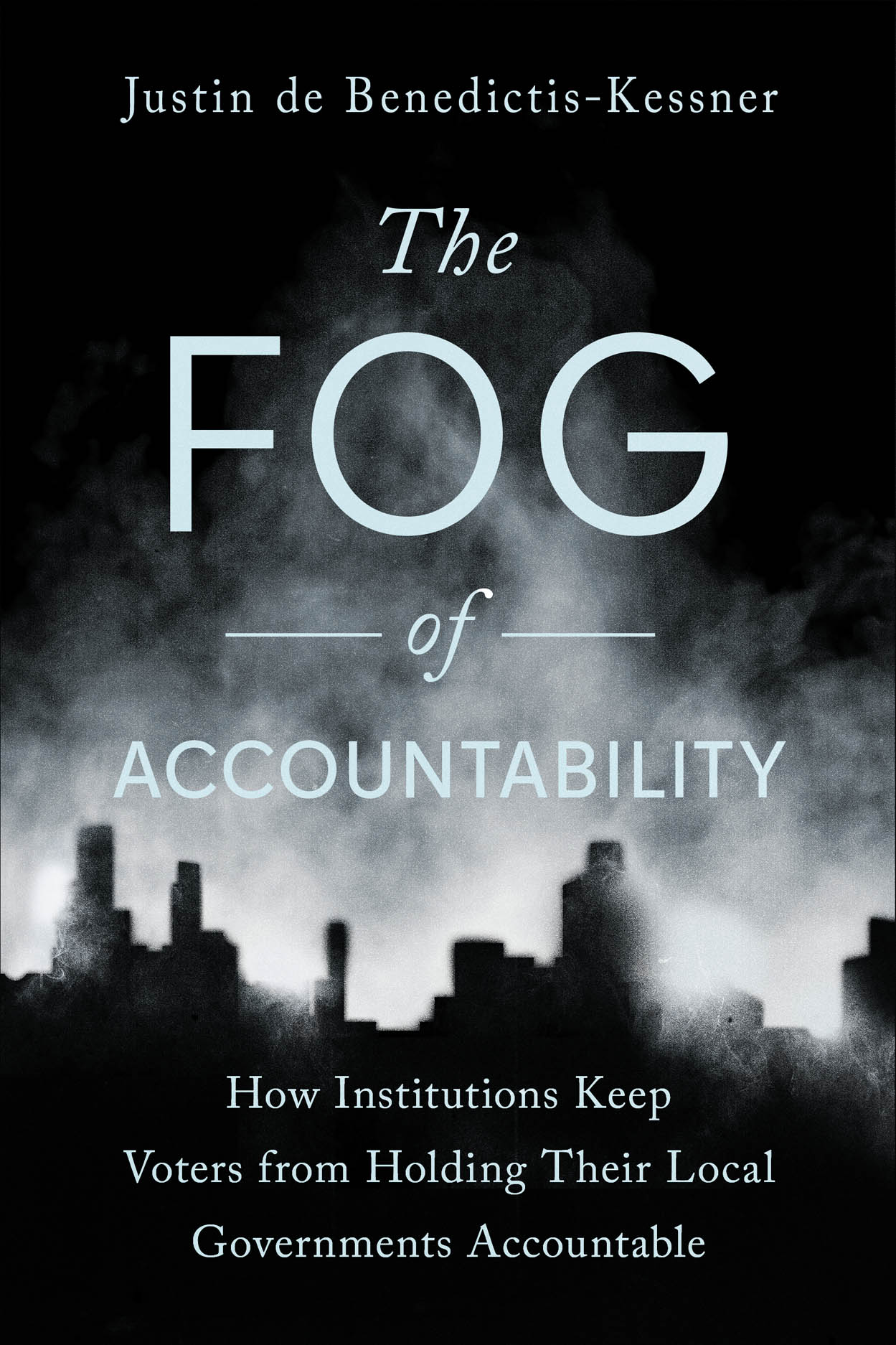
The Fog of Accountability
How Institutions Keep Voters from Holding Their Local Governments Accountable
The Fog of Accountability
How Institutions Keep Voters from Holding Their Local Governments Accountable
An astute, data-rich examination of the structural reasons that elections fail to hold US city officials accountable.
In the United States, hundreds of thousands of elected and appointed officials serve more than 50,000 subnational governments, making important decisions about services ranging from education to infrastructure to policing. The provision of critical city services shapes citizens’ everyday lives.
Supposedly, local politicians are the elected representatives closest to the people they serve, but are they actually accountable to their constituents? Justin de Benedictis-Kessner shows that they are not: local elections routinely fail to punish bad politicians or reward strong performers. The Fog of Accountability argues that this is because urban politics is defined by minimally effective competition, complex institutions that confuse voters, and a lack of effective media coverage. These institutional features combine to stymie even well-intentioned voters and make accountability difficult. Fixing these problems is challenging, but, as de Benedictis-Kessner shows, change is possible if we can enable citizens to reclaim and assert their political power.
272 pages | 60 halftones, 9 tables | 6 x 9
Chicago Studies in American Politics
Political Science: American Government and Politics, Urban Politics
Reviews

Table of Contents
List of Illustrations
1. The Fog of Accountability in Cities
2. Voter Knowledge Deficits Hinder Accountability
3. Ineffective Competition in Local Elections
4. Visible and Simple Problems Drive Incumbent Fortunes
5. Blurred Lines: Complex Institutions Complicate Accountability
6. Foggy Problems: How the Media Helps Voters Overcome Information Barriers
7. Strategic Finger-Pointing Can Hinder Accountability and Protect Incumbents
8. Closest to the People?
Acknowledgments
Notes
Bibliography
Index