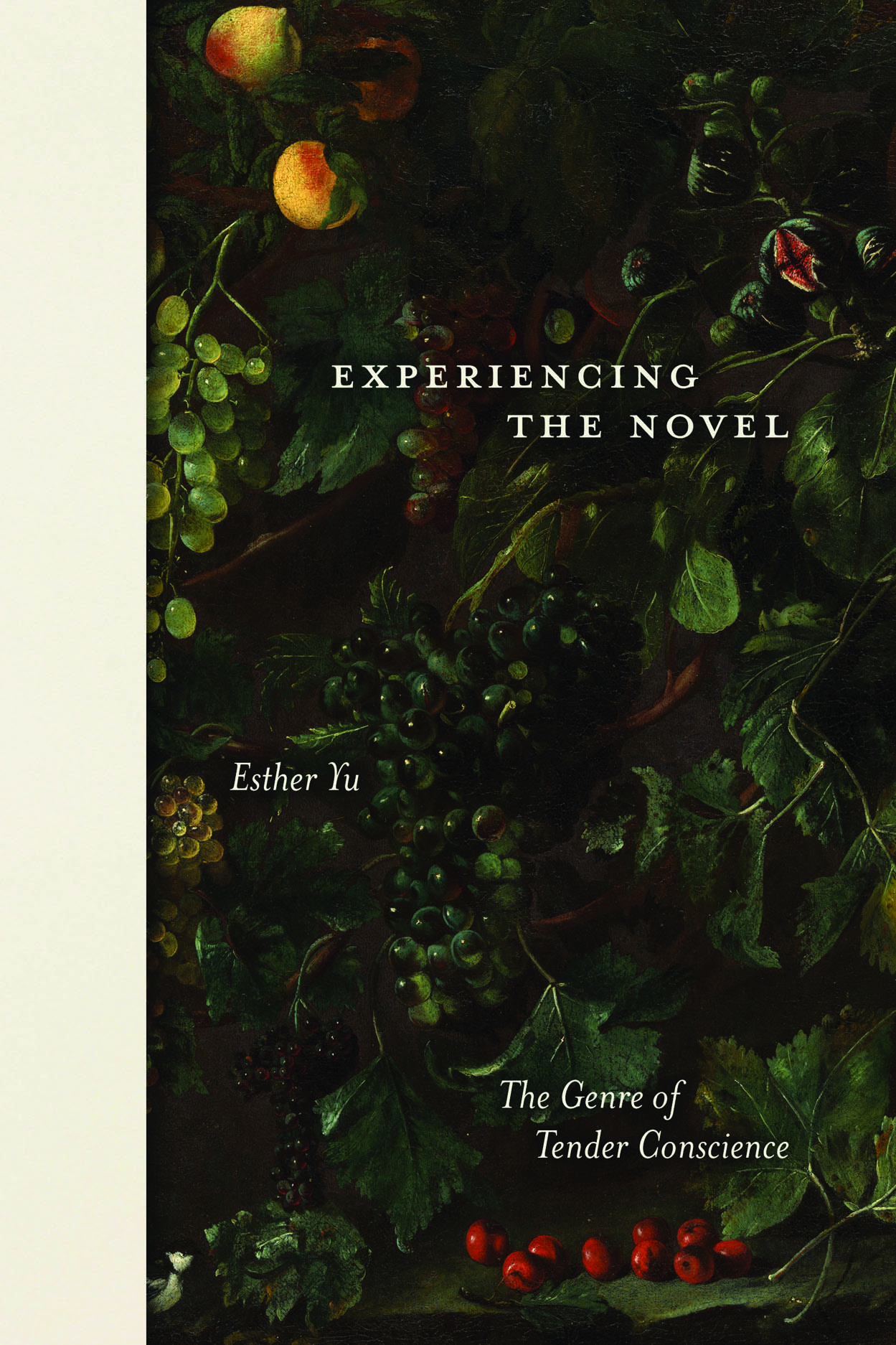
Experiencing the Novel
The Genre of Tender Conscience
Experiencing the Novel
The Genre of Tender Conscience
An innovative account of the novel’s emergence across revolutionary England and beyond.
Esther Yu’s expansive study in the history of the novel charts the growth of the “tender conscience”—at once a new mode of subjectivity and a shared structure of ethical obligation—that gave rise to the novel’s characteristic features. At the heart of the early English novel is a strange character: a hyperconscious observer who continually transforms perception into ordered, written narrative. Against longstanding accounts that tie the novel’s subjects to the emergence of modern individualism, Experiencing the Novel traces these endlessly impressionable figures to the mid-seventeenth century and the English Revolution, when citizen-subjects made public declarations of tenderness. It is through the recovery of such “tender consciences” that a curious fact can be addressed anew. The first people in Europe to cut off the crown with the head of their king began to tell stories differently: they took to narrating through an acute, sensitive register of first-person prose.
A forceful, community-binding complex of cognition, sensation, and ethics, the tender conscience persisted well into the eighteenth century. It was a large-scale structure forged across decades, one that demands the wide-ranging literary-historical account it finally receives here. Experiencing the Novel opens among brilliantly inventive Tudor-era works—Beware the Cat (ca. 1553), the Marprelate project (1588-89), The Unfortunate Traveler (1594)—that by turns experiment with and reject sensitizing modes of conscience. Yu further takes up an extensive, first-person care of the conscience—a tenderizing process enacted by little-known practitioners that carries from John Milton’s Paradise Lost into the writings of John Locke, the novels of Daniel Defoe, the moral sentimentalism of David Hume and Adam Smith, as well as Laurence Sterne’s Tristram Shandy and Samuel Richardson’s Pamela.
Through its vision of the long seventeenth century, Experiencing the Novel reveals an improbable practice of consciousness that remade popular politics, philosophy—and the culture of sensibility—from the margins.

Table of Contents
List of Abbreviations
Introduction Conscient
Part I. Literary Beginnings
1. Sensitizing (I): Beware the First-Person Novel
2. Sensitizing (II): The First Person in Late Tudor Prose
Part II. Political Extensions
3. The Tenderizing Process: Life-Writing as Practice of the Conscience
4. Tears in Paradise: The Revolution of Tender Conscience
Part III: Epistemological Ends
5. Staying Susceptible: Lockean Liberalism, Empiricism, and the Quaker Impetus
6. The Novel as Practice of Consciousness: Locke and Defoe, Revisited
7. Between Formal Realism and Moral Realism: Eighteenth-Century Sympathy, Sterne, and Pamela
Coda
Acknowledgments
Notes
Index