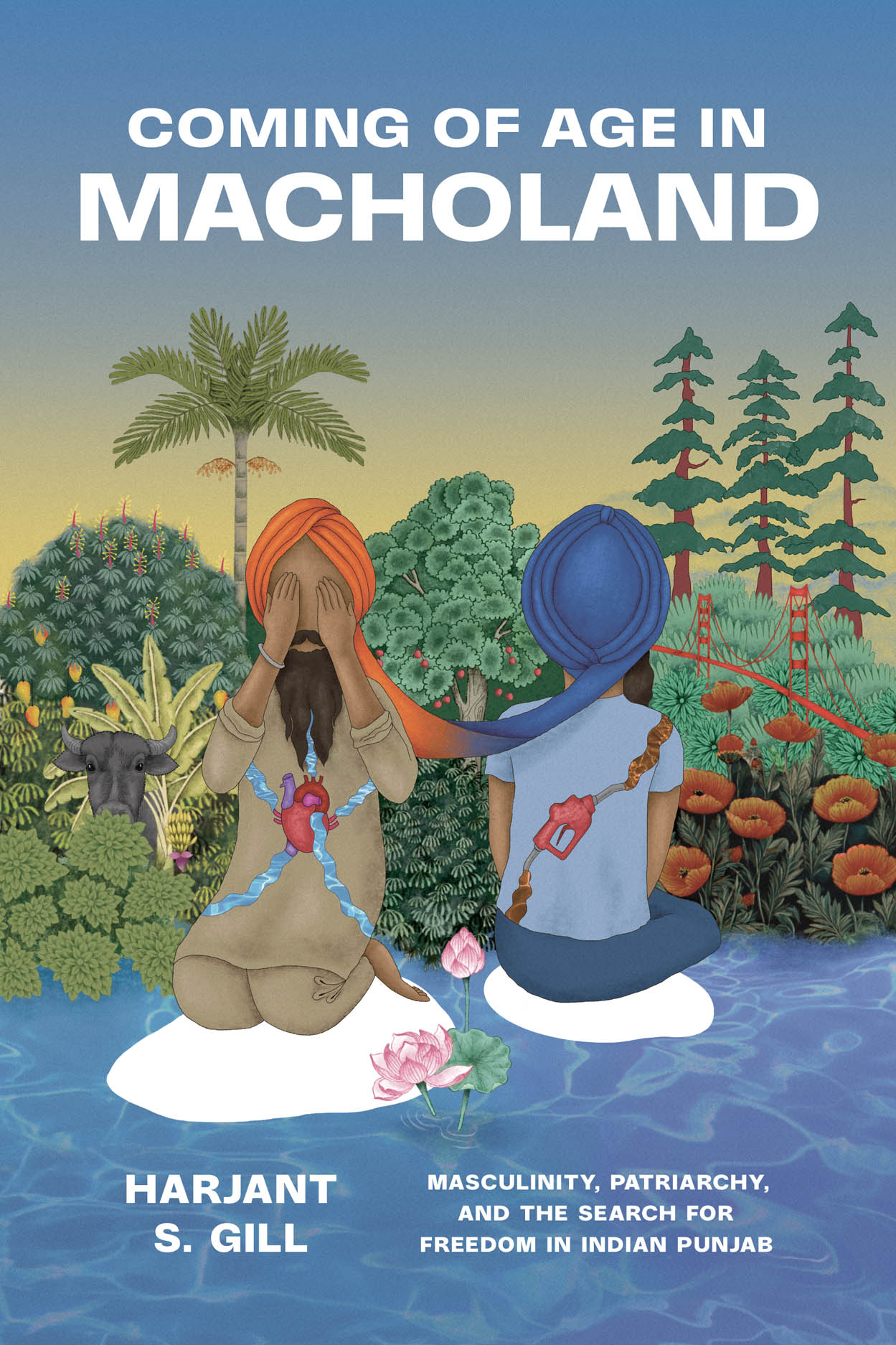
Coming of Age in Macholand
Masculinity, Patriarchy, and the Search for Freedom in Indian Punjab
Coming of Age in Macholand
Masculinity, Patriarchy, and the Search for Freedom in Indian Punjab
Through Punjabi men’s struggles to marry, migrate, love, and escape, Coming of Age in Macholand reveals what patriarchy costs the men it promises to empower.
In 2019, Sandeep, a twenty-seven-year-old from a Punjabi family, killed five relatives and himself after a date was set for his wedding. His suicide note described feeling trapped by social expectations and condemned to a life he had not chosen. Harjant S. Gill recognized something unsettling in his story. Gill grew up in Punjab as the eldest grandson of a Sikh patriarch before immigrating to California as a teenager. Although he built an openly gay life in Washington, DC, he returned to the closet for safety while researching in India, even as his grandfather sought a “suitable” bride for him. Gill could refuse marriage and return to America, but many men he met had no easy exit. What happens when patriarchy promises men power while denying them the freedom to choose who they will become?
Coming of Age in Macholand explores how young men respond to patriarchy—submitting, rebelling, escaping, and sometimes coming undone. Drawing on research spanning a decade, Gill enters the worlds of Punjabi boys learning to become men, where masculinity is shaped through violence yet sustained by emotional bonds. Amid political upheaval, a faltering agrarian economy, and migration hollowing out Punjab’s villages, this book portrays men struggling for power while losing intimacy and control over their lives. Blending memoir, ethnography, and social investigation, Gill exposes a system that brutalizes women and queer people while constricting the men it claims to serve. At a moment when men feel angry, lonely, and adrift, this book asks what they must relinquish—and reclaim—to become truly free.
304 pages | 29 halftones | 6 x 9 | © 2026
Anthropology: Cultural and Social Anthropology
Asian Studies: South Asia
Reviews

Table of Contents
Map of Indian Punjab
Notes on Terminology
Prologue
Introduction
A Suitable Match
Conceiving Macholand
Violence in Macholand
In and Out of Macholand
Chapter 1: Welcome to Punjab: Fly Nonstop from Amritsar to London
Border Crossings
Airports and Airplanes
A Transnational Punjabi Wedding
A Bungalow with the Eagle Water Tank
Learning English, Learning IELTS
Chapter 2: Initiations into Manhood
Morning Darshan
Initiations into Sikh Manhood
Threatening Sikh Manhood
Betraying Sikh Manhood
Jat Sikhs and Caste
Chapter 3: Coming of Age
Coming of Age in Chandigarh
Coming of Age in Punjab
Dating and Dreaming in Chandigarh
Heartbreak in Macholand
Chapter 4: Subverting Macholand
Being Gay in Macholand
Bending the Rules of Macholand
Becoming a “Proper” Boy
A Man with a Woman’s Soul
Chapter 5: Becoming Transnational in the “Modern” City
A “Modern” City in Global Times
Chandigarh Boys
Rural Men in the “Modern” City
Wayward Sons, Forlorn Mothers
Becoming Transnational
Chapter 6: Macholand in Diaspora
Coming of Age in California
Coming Out in the Diaspora
Finding Queer Belonging
Conclusion
Ways Out of Macholand
Author’s Note: Autoethnography as Methodology
Acknowledgments
Glossary of Punjabi Terms
Notes
Bibliography
Index
Excerpt
“In India today, normative understandings of gender and sexuality remain stubbornly tethered to an antiquated script, one written in the language of patriarchal families, arranged marriages, and caste-bound kinship. It is a script with few subplots and little room for improvision or rewrites. For middle-class men from privileged families and, in less visible ways, men like me, the instructions arrive vacuum sealed. There is only one acceptable ending, and it involves a bride, an extended family, and children; perhaps a son or two if one is lucky. Indian Punjab, as a region, still wears its hierarchies on its sleeve. Among one of the more socially stratified and patriarchal societies in the world, caste-endogamous or intra-caste marriage is less a rite of passage than a form of male accreditation. It is the stamp that sanctions one’s claim to manhood.
Over time, in my fieldnotes and anthropological reflections, I began to think of Punjabi society as “Macholand,” a conceptual terrain where manhood is manufactured, distributed, and policed. The term owes a debt to masculinity studies scholar Michael Kimmel and his formulation, Guyland, a framework for understanding how American college-age men absorb, rehearse, and reproduce the theater of masculinity. Kimmel focused largely on white, middle-class, heterosexual men in the United States as they transitioned into adulthood. I focus on dominant-caste Jat men in Punjab as they come of age. The cultural particulars differ. The underlying entitlement is strikingly similar. Punjabi men carried their masculinity and caste like a birthright, something inherited rather than earned. It wasn’t that they were cruel or selfish or chauvinistic. It was that they rarely questioned the forces that allowed them to get away with it. Their dominance was seldom contested. Few were ever asked to account for it. In Macholand, power is understood as natural, even God-given. Manhood is as sacred as caste. Privilege, of course, is invisible to those who grew up swimming in it. As I quickly realized, arguing with men about their gender and caste was like arguing with fish about the water...”