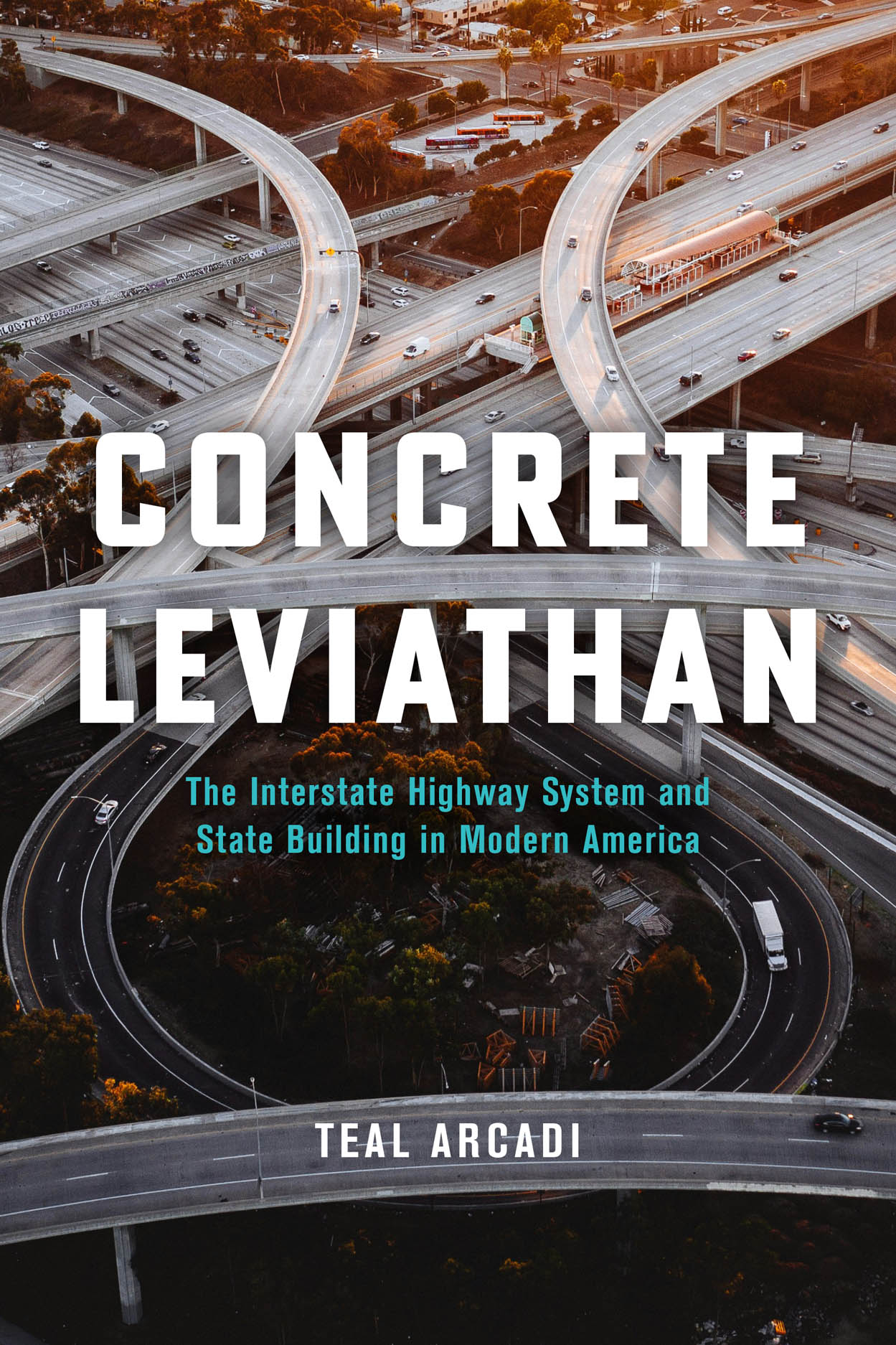
Concrete Leviathan

The Interstate Highway System and State Building in Modern America

Concrete Leviathan

The Interstate Highway System and State Building in Modern America

Publication supported by the Meijer Foundation Fund

Offers an insightful new way to understand the construction and consequences of the US interstate highway system, expanding and revising the common story.

In Concrete Leviathan, historian Teal Arcadi denaturalizes the interstate highway system, interrogating the ideologies, fiscal mechanisms, and legal tools that led to the construction of a vast and permanent physical infrastructure—and then made it all but impossible to change course. Arcadi argues that the US interstate highway system was built by an unaccountable regime of law and political economy that systematically created and insulated structures of governance. The power of these administrative and physical structures has been such that even when people have mobilized to oppose or try to change them, their protests have tended only to reveal the extent and power of the infrastructural state. 

At the same time, Concrete Leviathan shows how resistance to this infrastructure’s inequities generated new democratic ideas and practices, pointing toward more participatory structures of government and more equitable models of state building. 


272 pages | 32 halftones | 6 x 9 | © 2026

History: American History, Urban History

Political Science: Public Policy

Reviews

Scholars of infrastructure and urban planning have shown how the physical structure of our roads encodes patterns of movement and development in ways that make racial and economic disparities durable. In this revealing and timely new book, Arcadi deepens these arguments by showing further how the way we have built our infrastructure has shaped the nature of political power and governing institutions themselves in ways that challenge long-term values of democracy, participation, and effective governance. At a time where the question of reimagining governing institutions and capacity is front and center, and essential for the prospects for American democracy, Arcadi’s accounts of history, institutional development--and the commitment to a more effective yet democratic mode of future governance-- are essential reading for policymakers, scholars, and advocates alike. 


K. Sabeel Rahman, coauthor of 'Civic Power Rebuilding American Democracy in an Era of Crisis'

Table of Contents

Introduction: Road Work Ahead

Part 1: Constructing
1. Gasoline Dreams
2. Primed at the Pump
3. Men Working

Part 2: Confronting
4. Concrete Nightmares
5. No Place to Run
6. Shaken to the Foundation

Conclusion: End Road Work

Acknowledgments
Notes
Index

Be the first to know

Get the latest updates on new releases, special offers, and media highlights when you subscribe to our email lists!

Sign up here for updates about the Press